
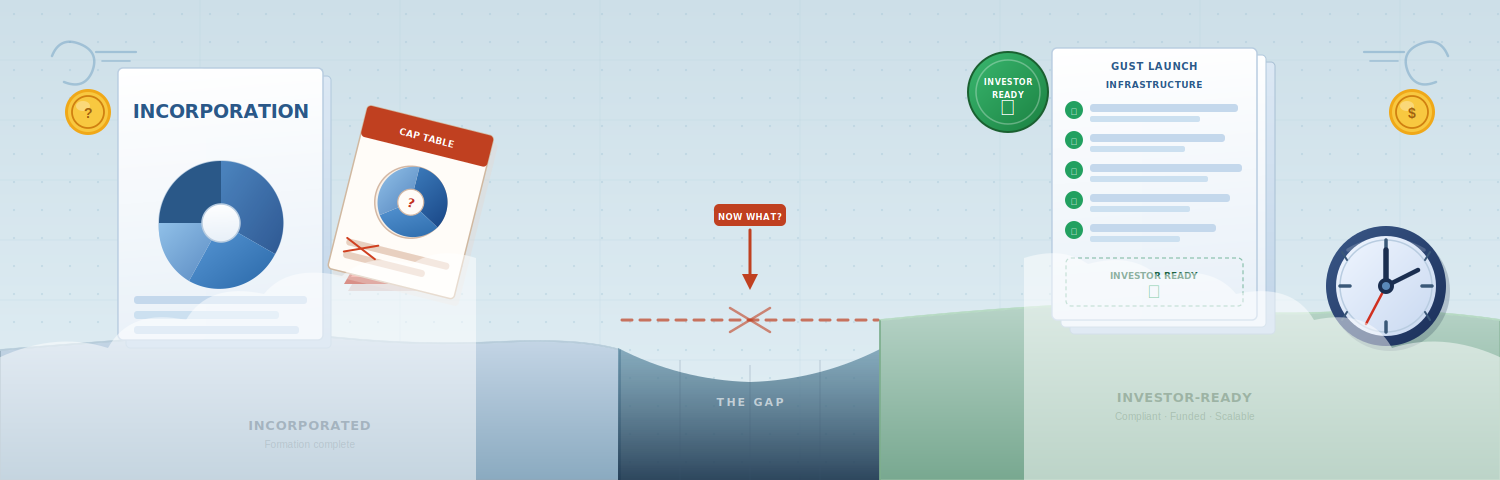
The Gap Between Incorporated and Investor-Ready

Your Delaware C-Corp Is Just the Beginning
Getting incorporated as a Delaware C-corp is the right call if your goal is to grow fast, one day be acquired, or even go public. It’s the structure investors expect, the entity type that scales, and the foundation for equity, fundraising, and growth. If you’re already there, you made a smart decision.
But here’s what most founders discover too late: incorporation is the starting line, not a finish line. The C-corp structure gives you the legal container but it doesn’t build what goes inside.
After formation, there’s a long list of things that still need to happen: equity must be properly issued, agreements signed, compliance deadlines tracked and the cap table maintained. Many founders leave all of this in the hands of lawyers—which works—until the billable hours start compounding. Others try to manage it themselves with spreadsheets and templates found online, which almost inevitably leads to mistakes that can cost a lot to clean up. Both paths introduce risk that usually surfaces at the worst possible time: in the middle of a fundraise.
The Gap Between Incorporation and Infrastructure
There’s a meaningful difference between having a legal entity and having legal infrastructure. One is a filing. The other is the ongoing operational and compliance backbone of your company.
Most formation services handle the filing. They get you incorporated, maybe set up a bank account, and send you on your way. What they don’t provide is a system for what comes next: generating and executing equity grants, staying ahead of required board approvals, issuing SAFEs or convertible notes in a fundraise, and managing who owns what and on what terms.
Without that infrastructure, founders end up in one of two situations. Either they’re calling their lawyer for every document or they’re winging it in ways that create real legal and structural risk. The latter tends to be invisible until an investor’s diligence process pulls on a thread and unravels something expensive or even broken.
What Investors Actually See in Diligence
Institutional investors have seen enough cap tables and corporate records to know when a company’s back office is clean and when it isn’t. Misissued equity, missing corporate actions, undocumented agreements, informal cap table records, conflicting terms across documents, inconsistent legal language… the list goes on. Individually, these aren’t disqualifying but they create friction. They raise questions. They slow things down. In fundraising, time kills deals.
A clean legal record signals to investors that your company is professionally run. It’s about risk, not just optics. Investors are taking on your legal history when they invest. An investor-ready structure removes that uncertainty from the equation before it becomes a negotiating point or a reason to walk. Not sure where your company stands? Run a free corporate diligence check.
What Gust Launch Does
Gust Launch was built specifically for this gap — the space between formation and fundraising readiness. We handle incorporation, but we don’t stop there. Unlike a law firm billing by the hour or a basic formation service that files and disappears, Gust Launch is the infrastructure layer that stays with you — keeping your Delaware C-corp compliant, organized, and investor-ready long after the paperwork is signed.
On the document side, founders can generate and execute startup-critical legal agreements without incurring legal fees for each new document. These aren’t generic templates. They’re the standard documents that investors and lawyers recognize and accept.
On the cap table side, Gust Launch gives founders a real platform to issue equity, manage ownership, and model dilution — not an easy-to-break spreadsheet, not a back-of-napkin calculation. An audit-ready cap table is one of the first things a serious investor will want to see. Having it organized and accurate from the start is far easier than reconstructing it under diligence pressure.
On the compliance side, it’s easy for deadlines and required approvals to fall through the cracks when a founding team is focused on building product and closing customers. Gust Launch surfaces those requirements and makes them straightforward to manage and complete. Each corporate action is supported by board and stockholder approvals, filing reminders, and ongoing compliance support built into the workflow rather than left to chance.
And when founders have questions, there’s real human support available. Not a chatbot. Not just a FAQ library. People who understand startup legal structures and can help navigate the journey. Our Mission Control community is there when you need a real answer from someone who’s been in the weeds.
The Cost of Waiting
The founders who get the most out of Gust Launch are the ones who onboard before problems develop. Cleaning up a messy legal history is always more expensive than maintaining a clean one. Reconstructing a cap table, tracking down old agreements, ratifying equity that was issued without proper documentation, are not quick fixes. They require lawyers, time, and often founder attention at exactly the moment it’s least available.
If you’re already a Delaware C-corp, you’ve established the right foundation. The next step is making sure the systems and infrastructure supporting it are investor-ready, compliant, and built to scale. And if things aren’t perfectly clean yet — that’s okay. Gust Launch can onboard already incorporated companies, helping untangle and organize what’s there at a fraction of the cost of custom legal work, because our process and software do the heavy lifting that lawyers would otherwise bill by the hour.
Ready to form a new Delaware C-corp? Get started here. Already incorporated? Click here and select “Manage my existing company with Launch” to bring your company up to investor-ready standards with Gust Launch.


Gust Launch can set your startup right so its investment ready.
This article is intended for informational purposes only, and doesn't constitute tax, accounting, or legal advice. Everyone's situation is different! For advice in light of your unique circumstances, consult a tax advisor, accountant, or lawyer.