
Stop Over-Engineering Your Startup. Trust the Process.

There’s a version of founder anxiety that doesn’t get talked about enough. The kind that makes you spend three weeks researching S-Corp elections before you’ve signed your first customer, or insisting on milestone-based vesting because you read a Reddit thread at 2am.
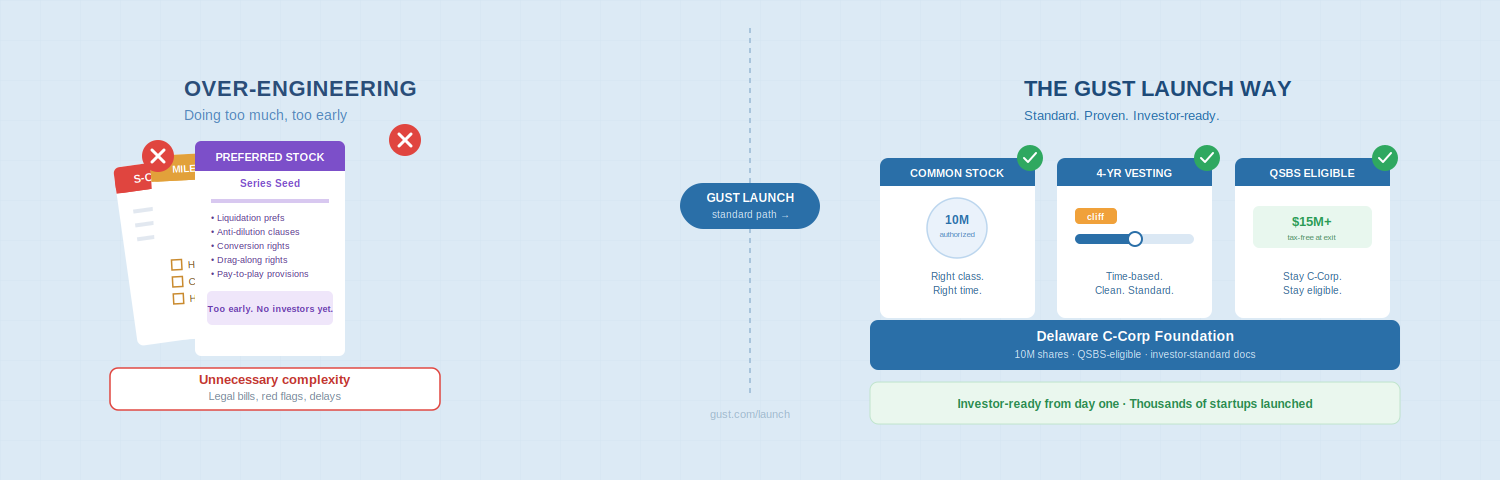
It comes from a good place. You want to get it right. But over-engineering your company structure before you need to is one of the most common—and most costly—mistakes early founders make. What we see again and again: founders who try to do too much too early end up with more complexity, more legal bills, and a messier company to show investors than the founders who trusted the standard path and stayed focused on building. The rule of thumb is simple: every standard deviation from what investors expect makes fundraising ten times harder, and it’s already exceptionally hard.
Here’s what that over-engineering usually looks like.
“I want to reserve shares for investors at incorporation.”
Investors generally receive Preferred Shares, or some kind of convertible instrument (SAFE, Convertible Note) before that round. It’s the class of stock that gives them the protections, preferences, and economics they expect in exchange for their capital. At incorporation, you don’t have investors yet. Setting up Preferred shares before a priced round is unnecessary, confusing to future investors, and potentially problematic for your cap table.
When you incorporate through Gust Launch, your company starts with Common Stock. That’s correct. Preferred Stock gets introduced later, during your first priced fundraise. The good news is you don’t need to plan ahead; don’t front-run it.
“Should I elect S-Corp status to save on taxes?”
This one sounds smart. Pass-through taxation, reduced personal tax burden, who wouldn’t want that?
The problem is what you’re giving up. If your startup has any chance of a meaningful exit, trading a small early tax break for a potential $15M+ tax-free gain is a bad trade. C-Corp stock that meets the requirements for Qualified Small Business Stock (QSBS) can generate up to $15 million or more in completely tax-free gains at exit. S-Corp stock isn’t eligible, period, and neither is LLC “equity” or ownership rights. The double-taxation concern that drives most founders toward S-Corp elections is also largely a myth for high-growth startups. Companies that reinvest revenue into growth rarely pay dividends, so the “second” tax almost never materializes. It’s also worth being clear with yourself about what you’re optimizing for: short-term personal tax relief and long-term gains in a shared enterprise are very difficult to pursue at the same time. Stay a C-Corp. Stay QSBS-eligible. Read more in our post S-Corps, LLCs, and Tax Savings for Startups.
“I want milestone-based vesting for my co-founder.”
Standard time-based vesting—typically four years with a one-year cliff—is what investors know, what lawyers recognize, and what works. It’s the industry standard for a reason.
Milestone-based vesting sounds logical in theory (“they only get equity if they hit their targets”) but creates significant problems in practice. Who decides if a milestone was met? What happens when goals shift? They inevitably do in an early startup. Milestone vesting invites disputes, requires expensive legal documentation, and raises red flags for investors in due diligence. Time-based vesting is the better approach. It gives founders the space to make reasonable judgments about a grantee’s performance over time, without locking the company into rigid targets that may no longer make sense. Gust Launch sets it up correctly from day one.
“I want every protection I can think of in my founder agreements.”
We understand the instinct. You’re building something valuable and you want to protect it. But layering in unusual protective provisions—super-voting rights, non-standard anti-dilution clauses, founder veto structures—before you’ve raised a dollar typically does more harm than good.
Investors expect standard documents. Non-standard terms don’t just slow down diligence; they signal inexperience, make investors nervous, and sometimes kill deals entirely. The legal protections that matter most at the early stage—IP assignment, restricted stock agreements, basic indemnification—are already built into the Gust Launch structure. The unusual ones you’re tempted to add often protect against problems you don’t have yet, while creating problems you don’t expect. If you want to protect your ownership stake, the most reliable path is to execute exceptionally well. That’s what gives you real leverage when negotiating terms in your next funding round.
The Gust Launch path exists because it works.
Gust Launch was built to help startups incorporate and build the right legal infrastructure for growth. Every default decision—10 million authorized shares, Common Stock at incorporation, standard time-based vesting, proper board approvals, clean C-Corp structure—reflects decades of experience from the investors, lawyers, and founders who built the startup ecosystem. These aren’t arbitrary defaults. They are the result of seeing what works at scale.
The founders who raise faster and cleaner aren’t the ones who customized everything. They’re the ones who got the foundation right, stayed lean, and focused on building a company worth investing in.
If you’re tempted to tinker with your structure, talk to us first. That’s what Mission Control is for. It provides real guidance from people who’ve seen every variation of this, so you can make informed decisions instead of expensive ones. If you’re ready to stop second-guessing and start building on the right foundation, get started with Gust Launch today.


Gust Launch can set your startup right so its investment ready.
This article is intended for informational purposes only, and doesn't constitute tax, accounting, or legal advice. Everyone's situation is different! For advice in light of your unique circumstances, consult a tax advisor, accountant, or lawyer.