
Yes, You Still Want a Delaware C-Corp (Billionaire Problems ≠ Startup Problems)

This write-up was originally sent to subscribers as a part of our Mission Control weekly insights, a series where we share wisdom and quick breakdowns on topics from our entrepreneur support network. Sign up for those here.
TLDR: Building a big company requires a collaborative effort between cofounders, early contributors, and investors. While recent headlines have some mega-rich founders complaining about Delaware corporate law, those are “post-success” problems most startups would love to have. For the rest of us actually building from scratch, structuring a company to support collaboration and investment from day one keeps everyone focused on the innovation that matters.
If you’re shooting for something big, a Delaware C-Corporation is still the default choice. The structure is purpose-built for collaboration and shared ownership, backed by legal precedent that gives investors confidence.
What makes a corporation the correct business structure for startups?
Out of the box, a corporation is set up to support the collaboration and shared ownership necessary to build a big company. A corporation has 3 levels of company governance—the structures that influence how the company is run:
- Officers who direct the day-to-day operations
- A board of directors that works with the officers on a regular basis
- A set of shareholders who collectively own the company and vote to appoint the board of directors.
In the early days, all 3 levels of company governance are usually occupied by the founders. But, to grow, the company will need to bring together a group of people to provide the necessary skills, sweat, and capital. Bringing those people together is a matter of aligning incentivizes and minimizing risks. Luckily, a corporation is built to make those things easy even in the earliest days when a startup is likely short on cash and support.
First, a corporate structure is automatically set up to enable collective ownership through shares. This makes it straightforward to split ownership between co-founders and to incentivize early contributors with ownership when they can’t be compensated in cash. When it’s not straightforward to issue ownership, startups often fall back on strategies—like promising equity but not issuing it—that jeopardize team members’ financial upside and leave the company open to future conflict or litigation.
Transparency and Tax Advantages
Down the line, investors may want to exchange cash for ownership in the company. Since they’ll be putting in large amounts of money into a risky venture, they’ll be looking to limit that risk by collaborating closely with the company. Luckily, a corporation is automatically set up to make that easy: through their investment, investors will either directly or indirectly have a say in who sits on the board of directors. This gives investors a behind the scenes view as the company is built and gives them influence over the appointment of the officers who run the company on a day-to-day basis.
To further incentivize everyone, there are tax advantages! Shares in new corporations often qualify under section 1202 of the IRS code, referred to as Qualified Small Business Stock or QSBS. If the original shareholder holds qualifying shares for at least 5 years before selling them, the first $15MM in capital gains are tax free*. This is a huge windfall for founders, early contributors, and investors alike. It’s not available for LLCs and it’s unlikely to be available to corporations that take the S-Corp election.
Why Delaware?
Delaware comes into the picture because it’s court system has built up a body of precedent around the state’s corporate code that is significantly larger than most other states. That means, even though the letter of the law is similar in many states, incorporating in Delaware gives everyone—especially investors—more confidence in how the law will actually be applied. One more piece of certainty in a fundamentally uncertain game.
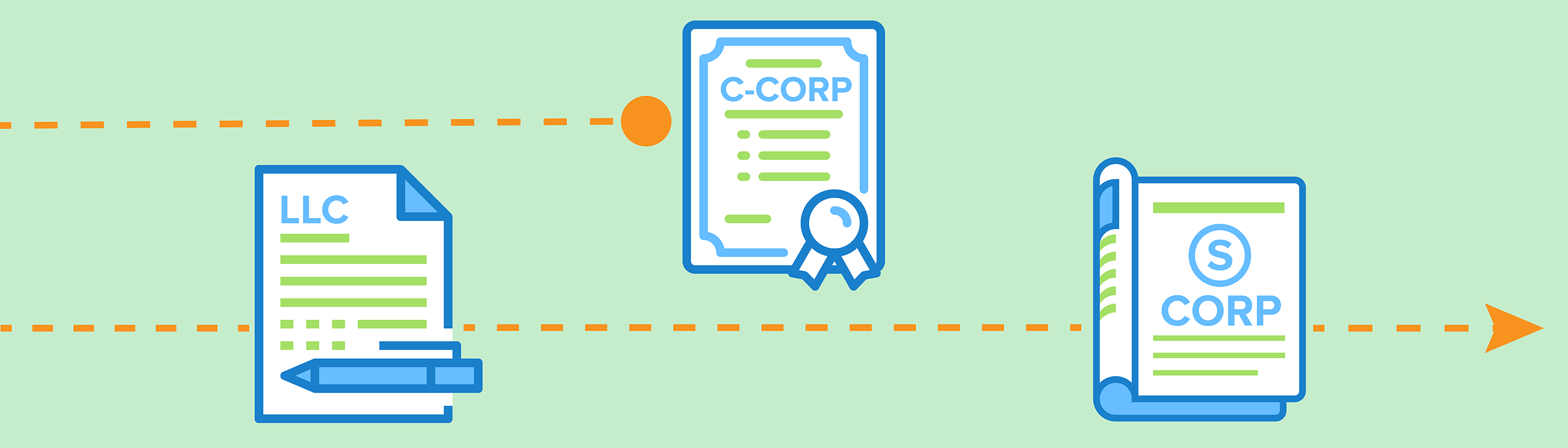
Often times startup founders will try to hedge their bets by starting with an LLC. It’s perceived as simpler and income tax advantageous. In reality, if you’ll be incentivizing team members with ownership or seeking equity investment to build something big, a Delaware Corporation is the better choice. Today’s platforms, including Gust Launch, make starting and managing a corporation straightforward and cost effective. And, any money you save optimizing for early income taxes will likely be outweighed by corporate cleanup costs and capital gains losses.
There’s a lot of overlapping terminology and advice out there when you’re “starting a company” and many founders get led astray during their legal entity formation. Gust’s Mission Control helps founders determine their path and make the best decision while knowing the full implications. You can leverage our tools and resources to help determine the right structure for your company even if you started as an LLC. If you have questions, come ask them at office hours!
* QSBS laws have been recently updated. The exclusion cap increased from $10M to $15M, companies can now have up to $75M in assets (up from $50M), and you can get partial tax benefits after just 3-4 years instead of waiting the full 5 years. These changes only apply to stock issued after July 4, 2025, but they make the Delaware C-Corp structure even more compelling for growth-focused startups. Stock issued before July 2025 can still get up to $10M in tax exclusion.


Gust Launch can set your startup right so its investment ready.
This article is intended for informational purposes only, and doesn't constitute tax, accounting, or legal advice. Everyone's situation is different! For advice in light of your unique circumstances, consult a tax advisor, accountant, or lawyer.